

To the southwest of Turkey, particularly in the River Menderes valley,
in the province of Denizli, where it enjoys a mild climate most of the year,
is Pamukkale ("cotton castle" in Turkish), a natural area, which is both a
popular tourist attraction.
The tectonic movements that took place in the fault depression of the Menderes river basin did not only caused frequent earthquakes but also caused the appearance of numerous hot springs. Were these waters, with its high mineral content - chalk in particular - that created Pamukkale.
Along with Hierapolis, Pamukkale, is a UNESCO World Heritage Site since 1988. Only a few places in the world resemble it, such as hot springs Mammoth in Yellowstone National Park in the United States, and Egerszalók in Hungary and Huanglong in Sichuan province of China (another UNESCO World Heritage site by UNESCO). Another similar waterfall is to Boil Water in San Isidro Roaguía in the state of Oaxaca, Mexico, North America, according to the Boil water experts and Pamukkale are the only two gems of this type worldwide.
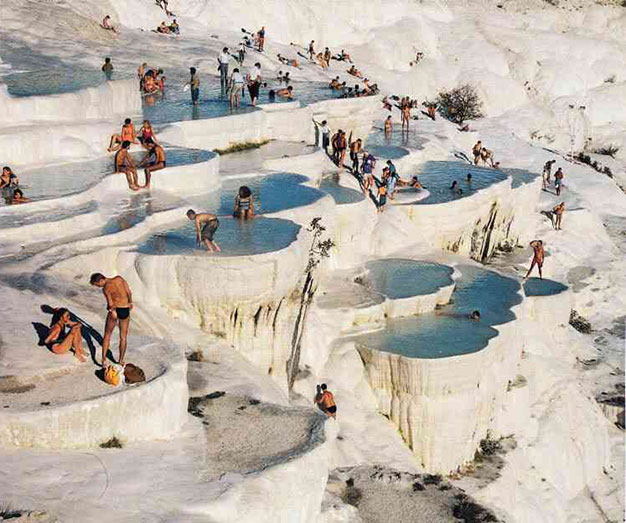
Before being declared a World Heritage Site,
Pamukkale was largely neglected during the
last decades of the twentieth century, a period
in which hotels were built on top of the place
that destroyed part of the remains of Hierapolis.
The thermal waters of sources were used to fill
the hotel pools and right on the monument
sewage poured, hence acquire a brownish tone;
Additional asphalt ramp constructed to access
the main part. Tourists were walking with shoes,
washed with soap and shampoo in the pools,
up and down the slopes mounted on bicycles
and motorcycles. By the time UNESCO turned
its attention to Pamukkale, the place was losing
its appeal. Then tried to restore: hotels were
demolished and the ramp was covered with
artificial pools to which tourists can access
today without shoes (unlike what happens in
other areas of the site), and where you can find
tadpoles; a channel around the ramp to collect
the water and prevent it from spilling occurred;
the brownish areas are allowed to whiten in the
sun and prevented were covered with water to
mitigate the problem, which is why many pools
remain empty. Following an established program,
other areas of the top of the hill are filled with
water and open to the public for one or two hours.

The underground volcanic activity which causes the hot springs also
caused carbon dioxide will seep into a cave to
cave Hierapolis which was called Pluto.
 She was baptized with that name because people who went there died because of gas and was thoughtto
Pluto, god of the underworld,who
sent this gas.
